
WHEN 20th-21st April 2026
WHERE Reed Hall, University of Exeter
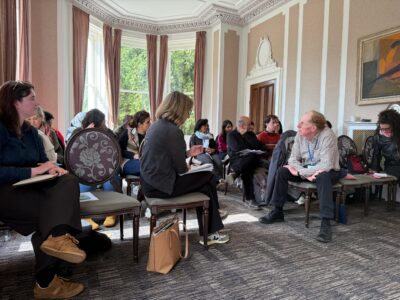
On the 20th-21st April, we brought together an international group of scholars in Exeter for a workshop on Thorny Matters: Health Politics between Ethics, Law and Life in SWANA.
The workshop attended to the relational and political aspects of different spheres of meaning-making to approach health phenomena as dynamically imagined, explained and negotiated.
Studies of contentious health phenomena have struggled to escape a focus on the formal bioethical deliberations and disputes within and between legal and medical institutions. Moreover, such studies often remain entrenched in frameworks of ‘metropole-periphery’. In our increasingly precarious times, it seems more crucial than ever to think about healthscapes as fluid, interconnected sites shaped by, and shaping, flows of people, concepts, technologies and commodities, at local, regional, and planetary scales. Understanding health phenomena means thinking more deeply, too, about multiplicities of knowledge and experience, and the often informal, or private, manners of their expression and exchange. These represent ontological and pragmatic challenges. They arise not only in definitions of wellness and crisis, but in pursuits of wellbeing that are navigated as ‘thorny matters’ within and between various domains of life – such as the clinic, the courtroom, the laboratory, the family, the legislature, the school room, the bedroom, and the street.
Papers were divided into four thematic strands:
Chronic Relationships and Social Life
The Community of Loss and Care
The Legal Body
Contagion and Care
The workshop keynote was given by Lara Sheehi, on the topic of ‘Psychic Militancy in Service of Revolutionary Futures.’
The outcome of the workshop will be a special issue.
Thorny Matters was funded by an SSHM Conference Award, an SWDTP ESRC collaboration fund, and the Wellcome Trust-funded project Living Addiction in States of Disruption.


 26-27 July 2023 Workshop Schedule